Tanzania
Protecting Chimpanzee Habitats in Gombe Stream National Park, Tanzania


Overview
Rainforest Connection (RFCx), Arbimon, Jane Goodall Institute (JGI), Gombe Stream Research Center (GRSC), and Tanzania Wildlife Research Institute (TAWIRI) partnered on an impactful passive acoustic monitoring project in Gombe Stream National Park, Tanzania, to better understand biodiversity patterns in the region. The goal of the present study was to use acoustic species identification algorithms, AI models, and soundscape analyses to assess the presence and distribution of wildlife, as well as the environmental factors influencing them.
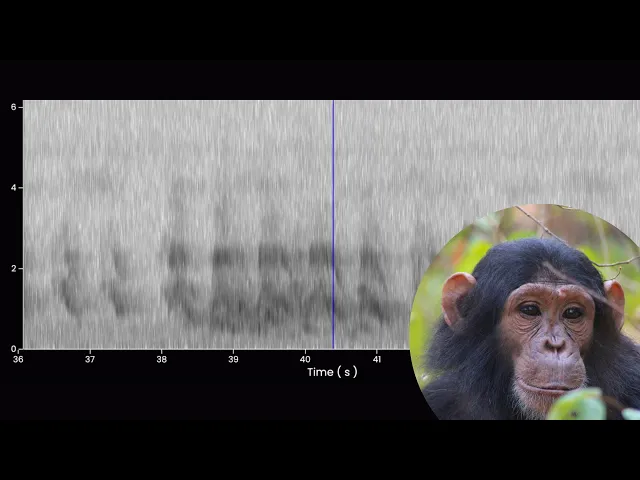
Above: Audio of chimpanzee (Pan troglodytes)
Partners
Jane Goodall Institute Gombe Stream Research Center
Tanzania Wildlife Research Institute (TAWIRI)
Tanzania National Parks (TANAPA)



Objectives
Use acoustic species identification algorithms, AI models, and soundscape analyses to assess the presence and distribution of wildlife as well as the environmental factors that influence them.
Develop a comprehensive understanding of the biodiversity in Gombe National Park and adjacent village forest reserves within the Greater Gombe Ecosystem, and to complement its rich long-term data across a gradient of biodiversity and people's land uses.
The goal was to create an acoustic baseline to understand both species diversity and distribution through in-depth biodiversity surveys.
Implementation
We implemented passive acoustic monitoring (PAM) within Gombe Stream National Park in Tanzania from October 14 to November 21, 2022 (dry season) and March 27 to April 29, 2023 (wet season).
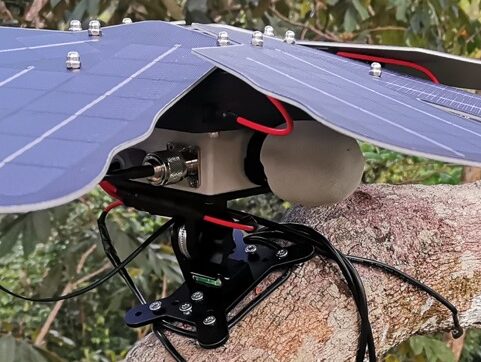
Our on-site partners deployed AudioMoth recorders (Open Acoustic Devices) across 100 sampling sites within the National Park during both sampling periods
We used 92 sites from the dry season and 79 sites from the wet season for further analyses.
Audiomoths recorded a one-minute audio clip every five minutes, resulting in 288 recordings per site per day.
Recorders collected data at each site for an average of 45 days combined. This resulted in 1,232,739 one-minute recordings, which were uploaded to the Arbimon platform for analysis.
Experienced biodiversity scientists from the RFCx science team reviewed project recordings in Arbimon. They manually detected and tagged species from one day of recordings at each sampling site to create a preliminary species list and identify potential data issues.
We used the validated PM detections as presence/absence data to train a Convolutional Neural Network (CNN) model to classify species from spectrogram images.
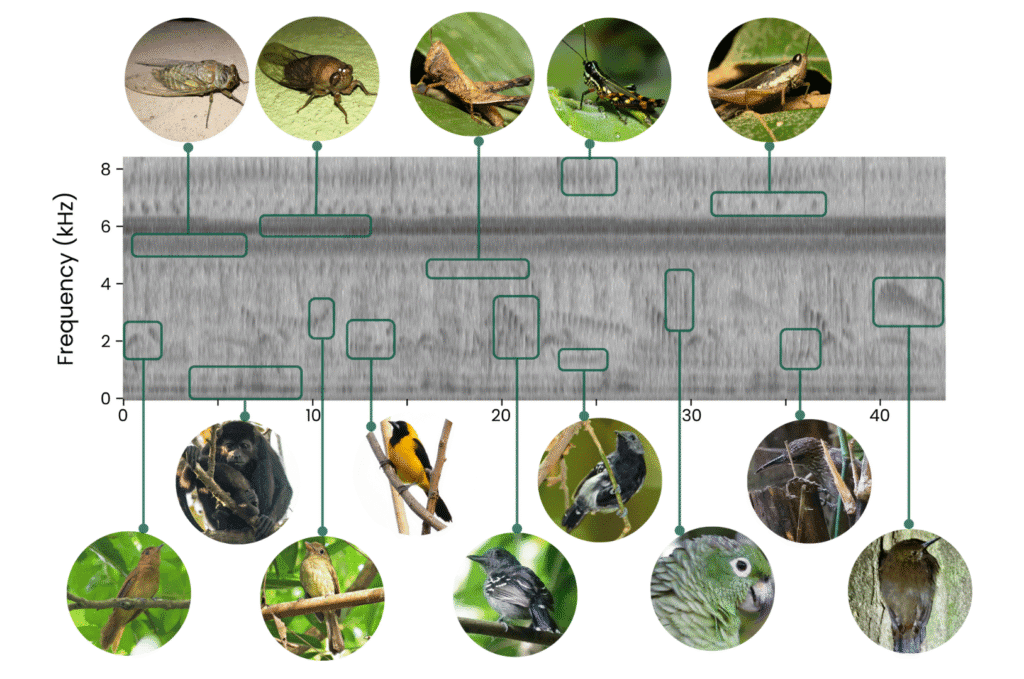
The final trained CNN model had 45 classes in raw sound recordings: 43 species+song-type classes and 2 genus+song-type classes.
Outcomes / Challenges
Outcomes:
On-ground partners collected data at 100 sampling sites in Gombe using passive acoustic recorders.
Used an AI-powered automated species detection pipeline in combination with soundscape and ecological analyses to derive biodiversity insights from across the park.
We identified 101 species across all sites, including 88 bird species, 11 mammals, and 1 amphibian. Notably, 4 species are on the IUCN Red List: the Endangered ashy red colobus and chimpanzee, the Vulnerable Oustalet’s red colobus, the Near Threatened crowned eagle, and the Data Deficient Mokanga forest tree frog across 98 sites in Gombe Stream National Park in Tanzania.
Documented the first detection of Thomas’ dwarf galago in Gombe.
Results show that seasonal changes are among the main drivers of soundscape composition, acoustic space use (saturation), species detection, and species occurrence.
Found that bird occurrence was positively influenced by taller vegetation and greater distance from human development.
Findings suggest that low-frequency acoustic activity is higher in areas with low-lying, dense vegetation near streams.
We found higher detection probabilities in the dry than in the wet season for both taxonomic groups at the community and species levels.
All primates had significantly higher detection probabilities in the dry season, except for Thomas’ dwarf galago; seasonal patterns for these species are more likely to be tied to changes in resource availability.
Results indicate that the likelihood of a bird species occurring at a location increases in areas with taller vegetation and farther from human structures. We found that species occurrence is positively related to tree height, with 51% of bird species showing higher occupancy probabilities in areas with taller trees.
Six bird species showed a negative relationship with proximity to human structures. Species such as the chinspot batis and olive sunbird (Cyanomitra olivacea), which are relatively widely distributed across the landscape, show reduced occurrence near human structures.
Findings suggest that variation in bird occurrence between seasons could be linked to the species' diet. Given that insect abundance in the environment can drastically decrease during the dry season, insectivorous birds may need to occupy larger areas to locate them.
Six bird species showed a negative relationship with NDVI (a measure of vegetation ‘greenness’), including the freckled nightjar and trilling cisticola (Cisticola woosnami), which live in open and semi-open habitats.
The blue-breasted kingfisher (Halcyon malimbica) has a high probability of occupancy throughout the park in the dry season; however, there is a notable reduction in its occupancy probability during the wet season, particularly in the southern part of the park.
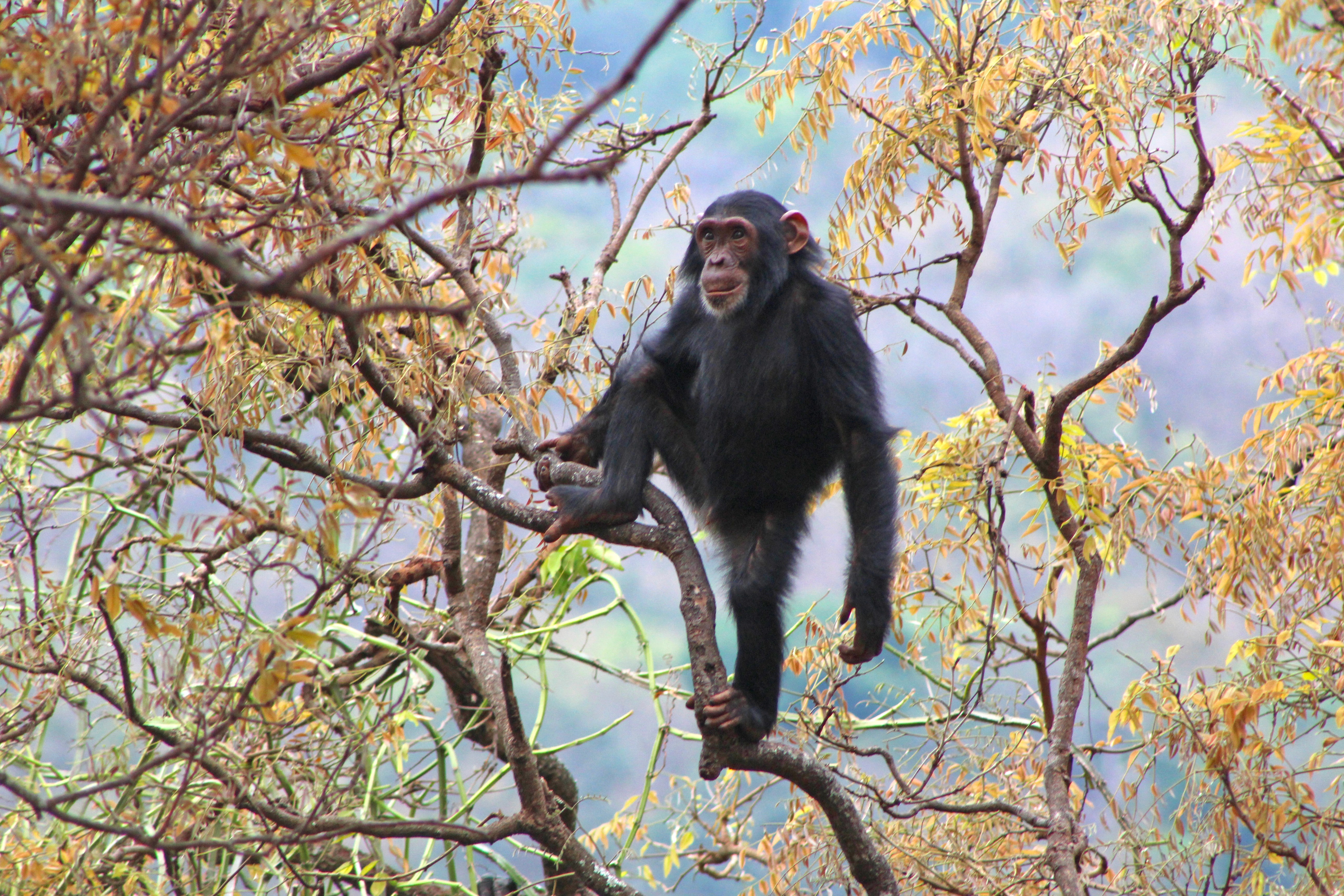
The predictive maps for chimpanzees suggest that they are more likely to inhabit areas <1100m, with denser evergreen vegetation (Figure 15). Notably, chimpanzee occupancy in the wet season is predicted to extend into the southern third of the park, even with the absence of species detections.
Challenges:
A number of sites had to be excluded from the analyses due to issues with the recordings
It is important to highlight that the inferences and insights drawn from MSOMs are inherently limited by the subset of species for which we had PM detections.