Protecting Columbia’s Rainforests Through Acoustic Monitoring


Columbia



Overview
RFCx worked with the Humboldt Institute, FBC, the Colombian Ministry of Environment, and local scientists to better protect and understand the middle Magdalena Valley ecosystems and its biodiversity.
The main goal was to protect critical ecosystems in Colombia from illegal activities and empower researchers and local agencies and communities with the insights and tools to study species of interest through ecoacoustics, including the blue-billed curassow, jaguar, South American tapir, and spider monkeys.
Partners
Humboldt Institute
Fundación Biodiversa Colombia (FBC)
HUAWEI Colombia
Objectives
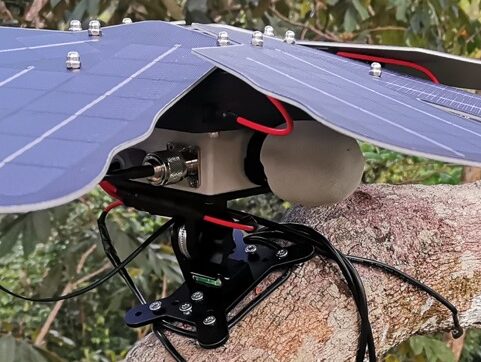
Deploy ten (10) real-time, long-term monitoring Guardian devices across the region to detect illegal activities and ship one hundred (100) AudioMoth Edge devices to the local team.
Implementation of real-time threat detection and biodiversity monitoring capabilites.
Protect critical ecosystems in Colombia from illegal activities and empower researchers and local agencies and communities with the insights and tools to study species of interest through ecoacoustics.
Alert for illegal activities associated with deforestation while simultaneously gathering data that can be used to track and monitor species over time.
Train the local team on deployment of AudioMoth devices/Guardian installation and the use of RFCx tools (such as the Ranger App and Dashboard)/train local partners and scientists on how to use the system to extract insights in the form of a workshop and support calls.
Create the project on the RFCx platform, add the sites, and upload the recordings to each site (guided by RFCx)
Create species-specific identification models for eighty (80) species of interest determined in collaboration with the Humboldt Institute and create species distribution models for the selected species.
Create a Regional CNN for a minimum of forty (40) species for continuous biodiversity monitoring over time.
Hoal is to establish mechanisms for smooth data transfer to enhance data availability and conservation efforts, with several alternatives and adjustments considered to align practices with existing data formats.
Implementation
RFCx shipped one hundred (100) AudioMoth offline devices that will be spread across the Magdalena Valley by the local team. Sampling design was decided by a collaboration between the RFCx science team and researchers from FBC and the Humboldt Institute.
Project Planning and Deployment Training
Several meetings took place between the RFCx team of ecoacoustics biologists and the Humboldt Institute to map out optimal locations for AudioMoth offline recording devices.
RFCx team trained the local team on deployment of AudioMoth devices. This does not require technical expertise on behalf of the on-ground partners.
RFCx shiped one hundred (100) AudioMoth Edge devices to the local team.
One hundred (100) AudioMoth devices were deployed strategically across the MagdalenavValley by the local team to effectively capture the biodiversity of the region, gathering data to do analyses.
RFCx will support the deployment of devices across the chosen sites a total of three times.
Additional surveys can be done using AudioMoth devices.
The local team will create the project on the RFCx platform, add the sites, and upload the recordings to each site (guided by RFCx).
RFCx science team will analyze the data in response to the question of determining an understanding of species presence and mapping 80 species of interest.
RFCx and the Humboldt Institute will collaborate to determine biodiversity indicators and soundscape occupancy analyses.
The RFCx team of expert conservation biologists will train local partners and scientists on how to use the system to extract insights in the form of a workshop and support calls.
The RFCx data science team will create a Regional CNN for a minimum of forty (40) species for continuous biodiversity monitoring over time. Depending on the number and quality of the training data more species could be included.
The results from RFCx science team and Humboldt Institute analysis will be reported on in a detailed report submitted at the end of the 1.5 year-long project.
All data will be continuously available to the Ministry of Environment and Humboldt Institute via the Biodiversity insights platform.
The study utilized an AI-powered automated species detection pipeline, trained using a Convolutional Neural Network (CNN), to analyze the acoustic data.
Integration of environmental variables into the occupancy models provided insights into how various factors like precipitation, forest structure, and vegetation health influence species detectability and occupancy.
Challenges:
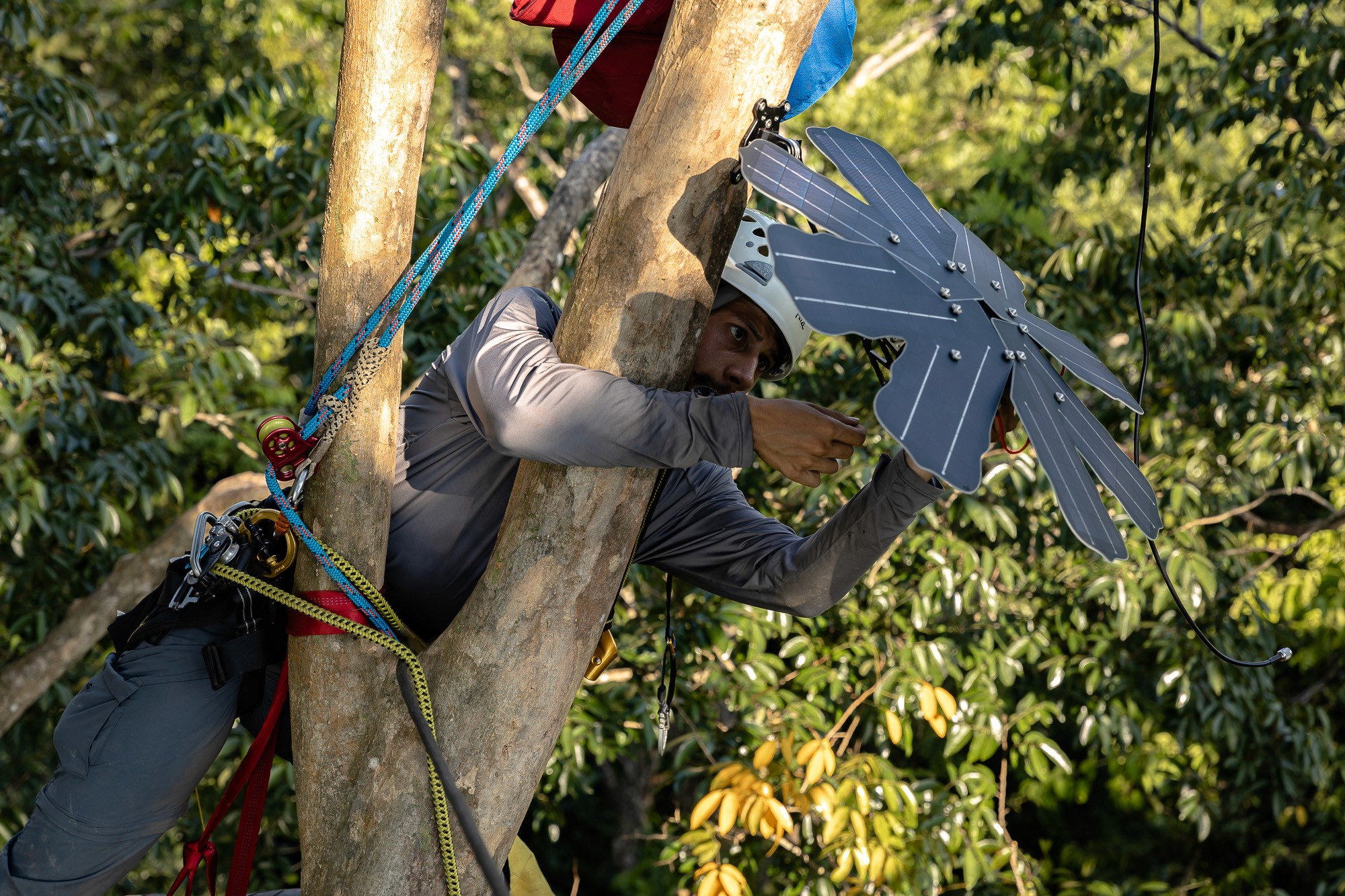
Technical constraints such as differentiating between chainsaw and grasscutter noises the need for canopy access for maintenance, and the lack of precise location data that complicates validation in difficult terrains
While initial community engagement showed promise, it was undermined by the technology's poor performance and high false positive rates.
Need for significant technological refinements and better integration with existing frameworks to ensure effective forest monitoring and conservation efforts
Model tended to incorrectly classify audio clips as having that species ‘present’ when the species was actually absent.
It is important to acknowledge that the insights derived from the MSOMs are inherently limited by the subset of species for which we obtained PM detections.
Impact
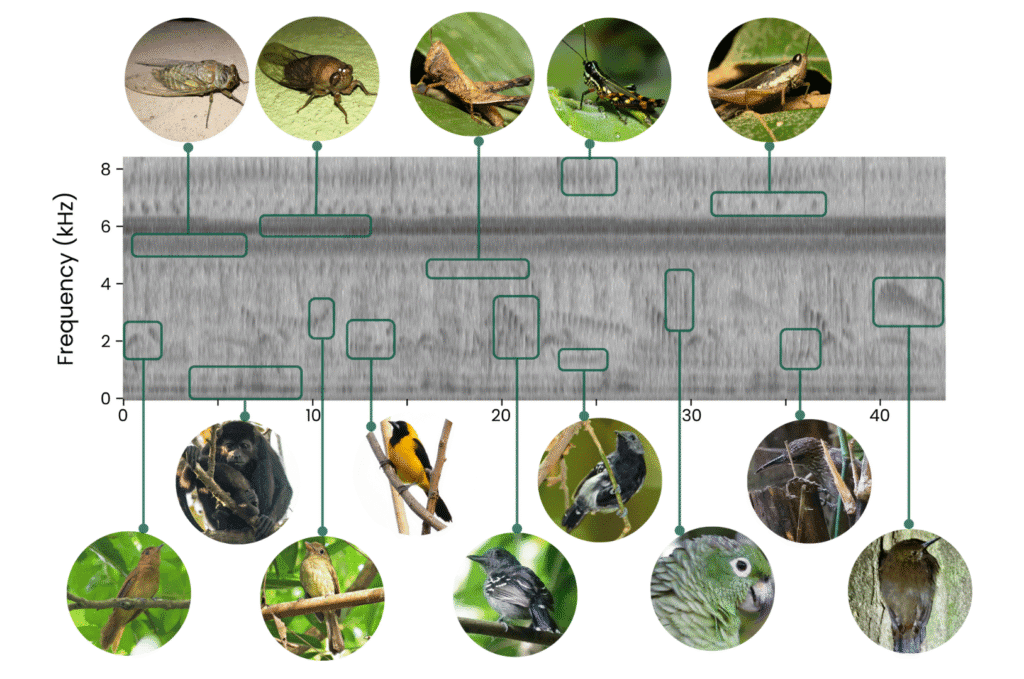
We detected a total of 151 species across 75 sites. This total consisted of 143 bird species, 4 amphibians, and 4 mammals (all primates. We detected 6 species threatened with extinction (IUCN Red List), Five of the detected species are
endemic to Colombia.Our analyses show that the forest structural condition index (FSCI) was an important predictor of occupancy for both frogs and birds. We also found that vegetation senescence influenced bird occupancy; sites with lower vegetation
senescence (i.e., lower water stress) had a higher probability of bird occurrence. Results suggest that as vegetation
senescence (i.e., stress or death) increases at a site, the probability of birds occupying that site decreases. This emphasizes the importance of healthy vegetation in supporting diverse bird communities.
(From June Pilot study)
Analysis revealed moderate correlations between acoustic indices and remote-sensing variables depicting forest integrity, such as canopy height and wetness.
We identified the remote-sensing variable that correlates better with acoustic variables, and the scale at which that
relation is stronger.With a wider gradient of sampling areas showed consistently weaker slopes in the relation, implying a less sensitive relations with ecosystem changes, although higher variability was explained in its models.
When examining the relationship between acoustic and remote-sensing variables, we found significant trends with variables that depict forest integrity—such as the structural condition index, which includes canopy height, disturbance, and forest cover—as well as radar variables that capture forest height and a wetness index.
Our results indicate that property-level comparisons are more effective, as the correspondence between acoustic and satellite variables varies slightly from property to property, more precisely following the habitat quality gradient within each property.
Our findings build on similar studies that integrate acoustic and satellite data to better understand ecosystem heterogeneity and recovery during restoration.
Studies collectively suggest that acoustic data can complement satellite remote sensing by providing fine-scale, temporal ecological insights that align with broader spatial data from satellites.