Protecting the Los Amigos ecosystem in Peru


Los Amigos, Peru

Overview
RFCx aided in the further development of an acoustic monitoring system that detects illegal activities while adapting the analysis tools and AI specifically to the Los Amigos ecosystem.
In 2019, RFCx began a partnership with ACA to test remote sensing networks in Los Amigos, Peru. Los Amigos in Southern Peru is situated along the confluence of Madre de Dios and Los Amigos rivers. One of the earth’s most biodiverse regions, the area holds an abundance of wildlife, flora and fauna. With over thousands of km of pure rainforest, the focus area for this project will be the buffer zone near Manu National Park.
The goal of the project is to examine the potential to use acoustic monitoring in the future to protect this critically endangered rainforest by creating a proof of concept for remote sensing and alerts for chainsaws as a way to monitor illegal logging. The RFCx system is also designed to nest within REDD+ projects such as Alto Mayo, which require a data and monitoring component to establish benchmarks related to protection.
Partners
Amazon Conservation Association (ACA)
Osa Conservation
Objectives
Install RFCx Guardians to send real-time alerts to partners on the ground to stop illegal logging. (10 Guardians in total in Los Amigos)
Transforming the existing towers as hubs for connectivity in the rainforest.
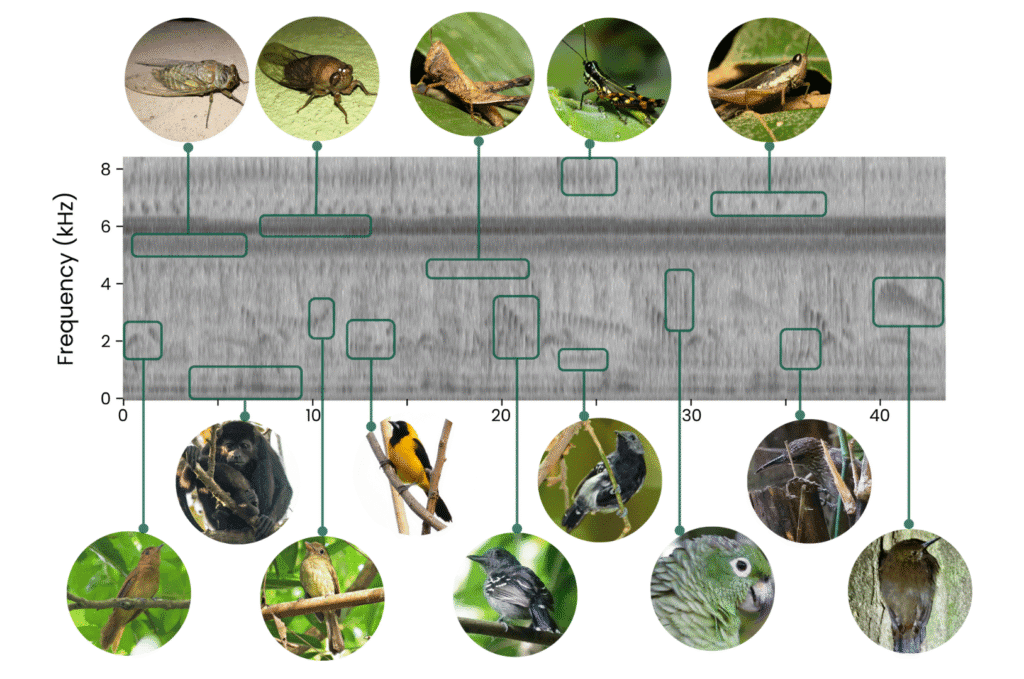
RFCx will train the Los Amigos science team on the RFCx Arbimon platform, enabling them to use acoustics to analyze biodiversity presence via an Ecoacoustics Analysis Workshop.
Train local rangers on the use of RFCx tools (Ranger App and web console) through a formal workshop and supplemental calls as needed to ensure they are well-equipped to utilize the RFCx monitoring platform.
Train local rangers on the use of RFCx tools to ensure they are well-equipped to utilize the RFCx monitoring platform.
The system will capture and archive forensic evidence of illegal activity for prosecution. RFCx team will collaborate with the local partner to customize the data output reports to be used as forensic evidence to present to the relevant authorities.
Train the Los Amigos science team on the RFCx Arbimon platform, enabling them to use acoustics to analyze biodiversity presence via an Ecoacoustics Analysis Workshop.
The ten (10) species will be added to an existing Peruvian Amazon Regional CNN with many more species detections. Together, this CNN will be available to be run over Los Amigos acoustic data for automatic detection of species.
Implementation
Implementation Details:
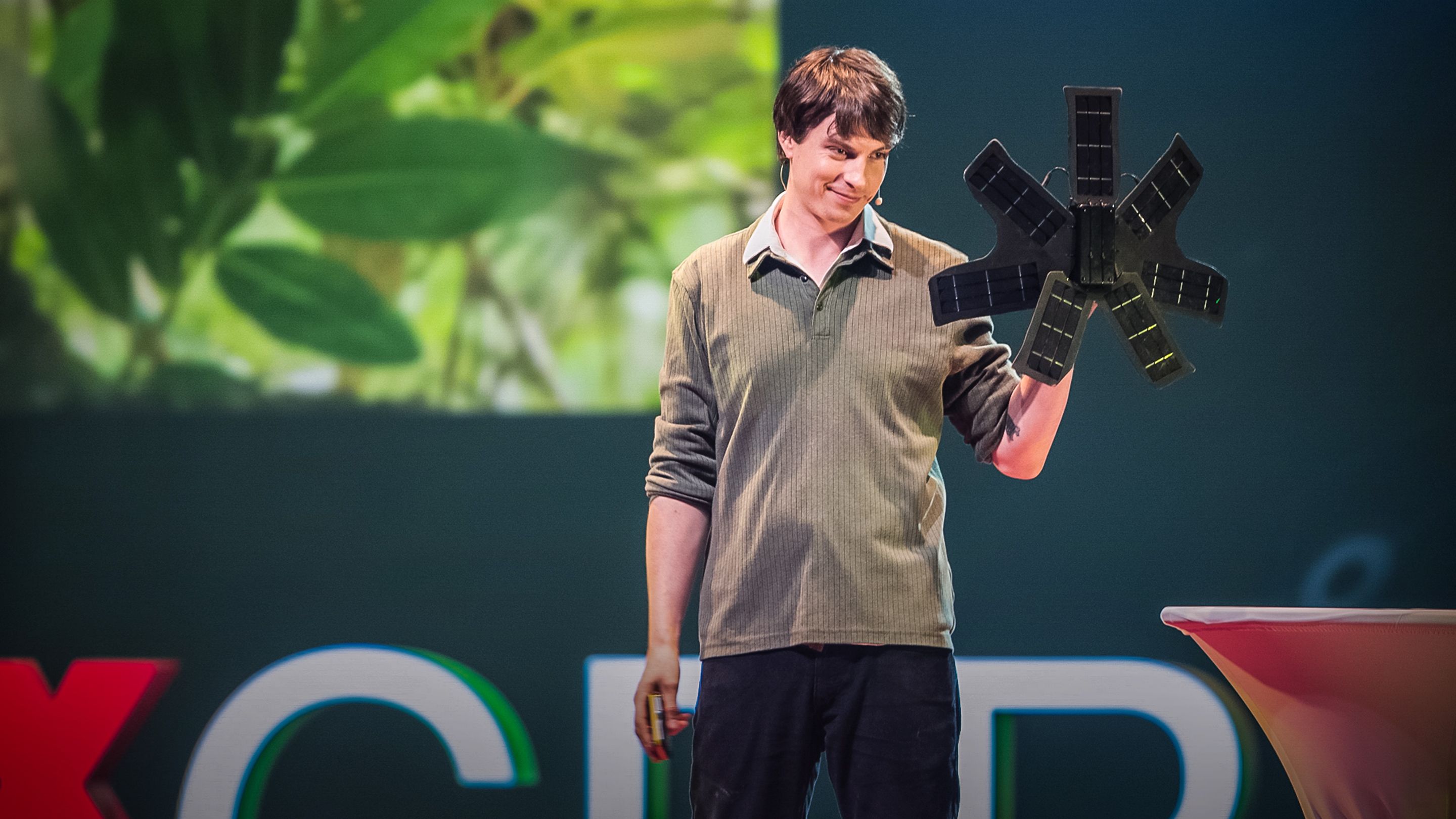
The first scoping field visit in October 2019 was led by Topher White from Rainforest Connection and Andy Whitworth from OSA conservation along with Arianna Basto from Conservación Amazónica. Adrian Forsyth and Haley Wiebel from Andes Amazon Fund also joined the expedition for the first week to observe the process and confer with the team.
Specific Project Activites:
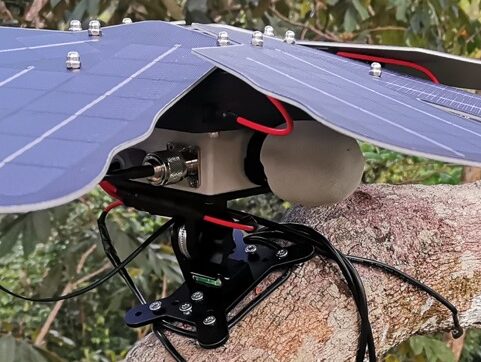
Repeater Network System Location Mapping: Rainforest Connection team worked closely on-site with the project team to identify and map key strategic locations for the installation of the Repeater Network, RFCx Guardians and camera traps.
Repeater Network System: Project team successfully installed the autonomous repeater network system.
Audio Ark: RFCx devices were successfully installed and are currently collecting hundreds of hours of data per month. To date, 608 hours or data have been collected and added to the audio ark.
RFCx Streaming Application has live link to the Guardian in Los Amigos to create more awareness about the project. In the past twelve months, there are 5590 Individual Users from the general public who have streamed the sounds of the rainforest from RFCx streaming application.
RFCx Real-Time Alerts Generated: To date, over 500 alerts have been generated. These alerts are available on the RFCx Dashboard for review and action.
Camera Traps
Three different models of Camera Traps were field tested by Andy Whitworth during this scoping visit.
Below are the results of the test:
Spartan Model GC-A 4GB: This model was considered the best of the lot. It was easy to set up and worked with the peruvian sim card and was able to send photos to either an email or a phone number.
Boly Model MG983g-36m: This model had a very complicated set-up and took the team very long to get it to work. It also didn’t work with the local peruvian sim card however it did work for a short while with a T-mobile sim.
LTL ACORN Ltl-530 Series 1080P: This camera trap model completely failed the field test as it broke within 20 minutes.
Impact
Challenges:
One of the early challenges faced by them was hauling the heavy equipment up the 60 meter tower. Since the equipment was heavy and bulky, it could not be manually carried to the top. Therefore, the team devised a makeshift pulley system from the top of the tower and hauled the equipment in suitcases.
The equipment and gear was constantly being attacked by the ants, rodents and bees in particular. If the team would leave the gear on the ground for a couple of hours and come back, they would find it damaged and covered in ants. The tower proved to be safer as the rodents would normally not scale to tower.
The cable that would be used to connect the donor antenna system to the repeater system was heavy and highly sensitive. The team decided to to connect it over the tree canopy, due to the cable available and the tower height. Finding the right tree became a major challenge as it needed to be the right height and strong enough so that the team could climb it. This took several hours and the team had to test with multiple trees before finding one that could work for this set-up. The power cable had to be suspended like a zipline on a tree that was 40 meters high over the tree canopy directly to the tower. This was very physically challenging as the team member had to climb multiple trees to get the support wire first across to the tower.
There were many unknown factors that could be contributing to the weak signal. After careful deliberation, the team decided to find a way to boost the signal from the donor antenna and amplify it on site prior to the signal travelling to the repeater. The challenge was that the antenna was already as high as it could be installed and couldn’t be moved further. The team took a Guardian and repurposed it’s parts to provide a power source for the amplifying repeater. This took several hours to set up however once completed, the team had the repeater working at the tower. This was a successful moment for the team as all connections were stable and performing as needed.
The next morning, when the team got to the site, they saw that the system had stopped working. The team checked the repeater site, the cables and then the donor antenna site to investigate the issue. They found that during the night, some animal or rodent had eaten through the power cables of the amplifier that was connected to the donor antenna. The team then decided to add more solar panels to the power device and also embedded it in silicon so that the animals couldn’t get to the cables.
The team then set out to create the broadcast signal from the repeater. The major restriction with the repeater network is that the signal cannot be accessed from all directions. It can only be in the opposite direction of the donor signal which limits it to a 120 degree coverage. However the team configured the repeater network system and created the broadcast signal which was then tested by the on- ground field team.