Brazil
Biodiversity Monitoring in Brazil’s Juruá Region


Overview
Rainforest Connection (RFCx) partnered with Instituto Juruá to understand biodiversity patterns in and around floodplain lakes of the Juruá River, in the Brazilian Amazon, using passive acoustic monitoring (PAM). More specifically, the project aimed to test whether community-led lake protection through fisheries management has a positive effect on other non-aquatic fauna, such as birds, primates, and anuran species.
Partners
Instituto Juruá

Objectives
Evaluate how different protections and community-based conservation strategies influenced biodiversity levels near these floodplain lakes.
Test if lake protection by the community through fisheries management has a positive effect on other non-aquatic fauna, such as birds, primates, and anuran species.
To understand if local community protection of floodplain lakes has a positive impact on overall biodiversity and soundscape.
The study focused on comparing the acoustic characteristics of protected and unprotected lakes, as well as those within the forests surrounding them.
Implementation
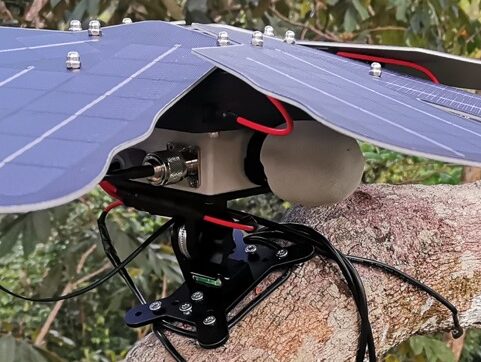
Deployed specialized acoustic recorders at 144 sites across 18 floodplain lakes (9 under community protection & 9 without protection) from September-November 2022.
Passive acoustic monitoring (PAM) was conducted in 18 floodplain lakes in the Juruá River region of the Western Brazilian Amazon, with 9 designated as community-protected and 9 as unprotected.
Open Acoustic Devices were used to collect 60-second audio recordings every 11 minutes (approximately 130 recordings per day) at each site for at least 1 week from September to November 2022. A total of 131,706 1-minute recordings were collected by AudioMoth recorders and uploaded to the Arbimon platform by on-ground Instituto Juruá partners.
Two biologists from the RFCx science team with extensive experience in audio surveys (GL and TM) used the Arbimon online platform to listen to recordings and manually inspect the spectrograms of one day from each sampling site (i.e., first or last survey day) to create a preliminary list of species from the study area.
We created PM models for 51 species (Appendix B) in Arbimon to automatically identify the species in the audio recordings using the parameterization.
Limitations:
Data collection was carried out during the dry season; in floodplains, seasonality may influence the detection of some species and the soundscape patterns, which can change drastically during the rainy season (Melo et al. 2022). With additional data collection during the flood season, we would be able to compare species occurrences and soundscape outcomes across both seasons and assess seasonal variation in acoustic variability and population dynamics for many vertebrate species.
Outcomes / Challenges
Outcomes:
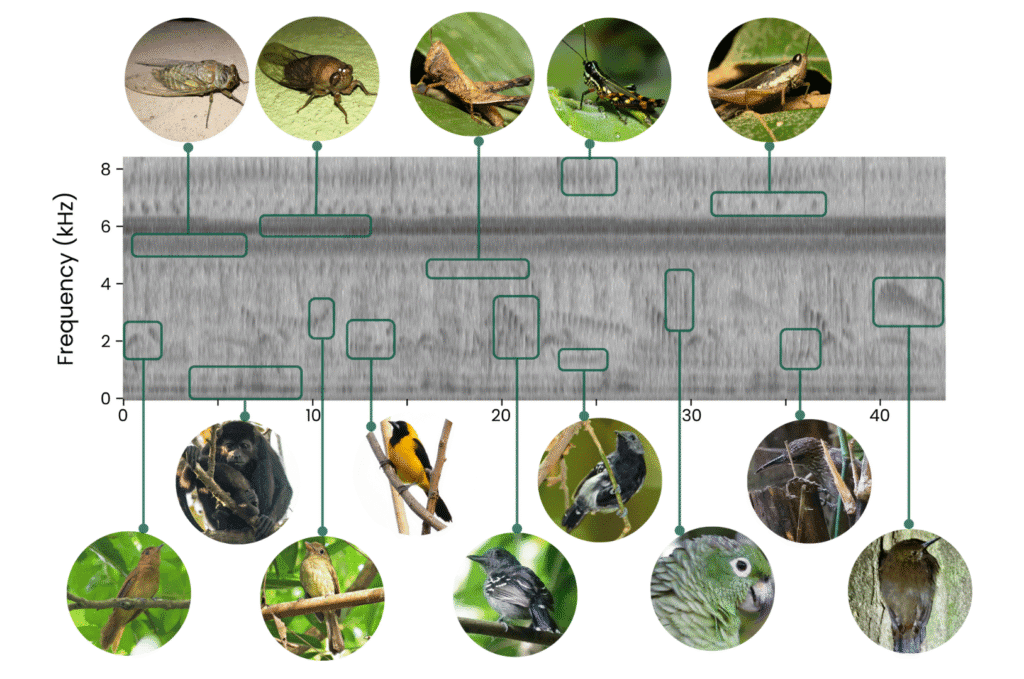
We detected 174 species in total (164 birds, 5 mammals, 5 amphibians), including 4 species threatened with extinction:
Wattled curassow (Crax globulosa)
Ringed woodpecker (Celeus torquatus)
Zimmer's woodcreeper (Dendroplex kienerii)
Razor-billed curassow (Mitu tuberosum)
We developed species detection and identification models for 51 of the most ecologically important of these species.
We used proven acoustic-based proxies (soundscape metrics) for species richness and composition to show that protected lake sites have higher species diversity than unprotected lake sites. This result highlights the positive impacts of community-led conservation and management on biodiversity and underscores the need to continue supporting grassroots conservation initiatives.
This project has enabled real-time ecoacoustic monitoring in the region, providing important insights into the effects of protected status on biodiversity around floodplain lakes in the Brazilian Amazon. Project results have been made publicly available through an intuitive, digestible Insights page to facilitate collaboration and knowledge sharing.
These analyses suggest that protected floodplain lakes have a unique and more variable soundscape signature, indicating that soniferous animal species differ between protected and unprotected lakes.
The results suggest that lake protection by local communities through fisheries management spills over beyond lake boundaries and positively impacts soniferous fauna, resulting in greater richness of soniferous species around protected lakes than around unprotected ones.
Overall, 4,685 detections generated by the PM analyses were manually validated.