Austria
Protecting Biodiversity at Lake Neusiedl, Austria



Overview
The goal was to answer a multitude of questions regarding the current conservation status and ecology of species in the reed belt of Lake Neusiedl, a European biodiversity hotspot for wetland vertebrates.
Partners
Huawei Australia
University of Vienna
Lake Neusiedl National Park



Objectives
Assessing the occurrence and population density of wetland birds and amphibians in the reed belt during their reproductive period, to evaluate their current conservation status.
Identifying the characteristics of the ecological niches of reed birds and amphibians across an
environmental gradient from the lake’s siltation zone to the reed edge - to predict effects of future spatial habitat shifts caused by climate change.Quantifying the seasonal importance of the lake’s reed belt for birds.
Implementation
Adopted the AI model methodology outlined in LeBien et al. (2020) to develop a regional species classification model.
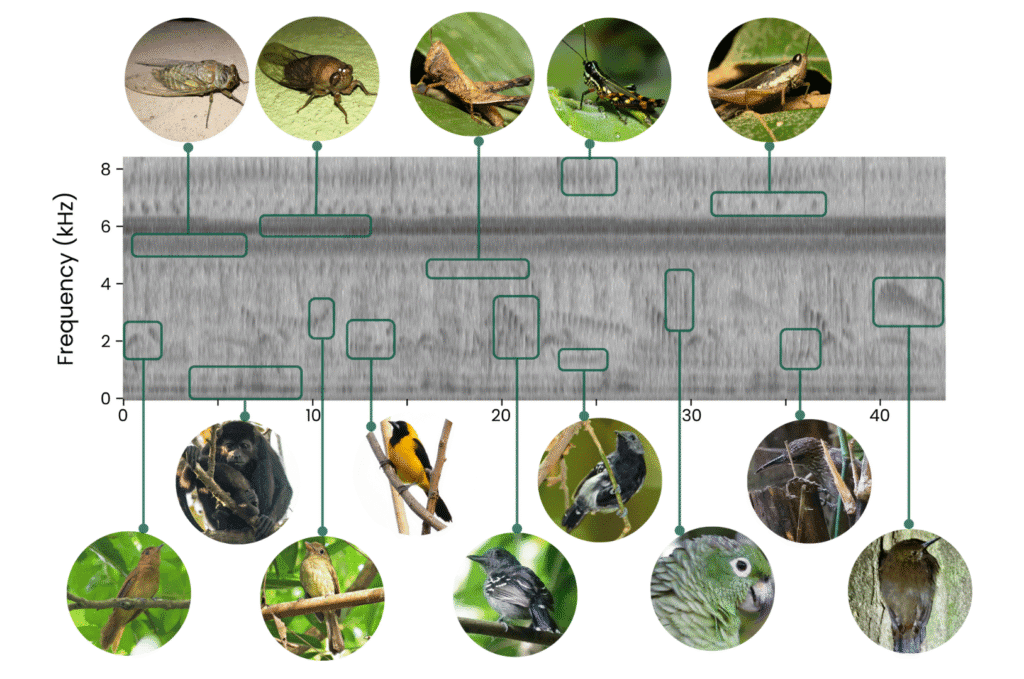
We implemented a deep learning pipeline that uses a Convolutional Neural Network (CNN) to classify species from spectrogram images.
Our partners used Arbimon’s Pattern Matching (PM) tool to automate the training data acquisition process, allowing users to select an acoustic signal template (i.e., an example of a species' vocalization) and then search through a user-defined playlist of audio recordings to identify signals that match the selected template.
In addition to data labeling through the PM tool, we also employed another analytical method called "Negative Pattern Matching" to gather more absence clips for the training dataset that introduces random background noise into the training data, which can help reduce the number of false positive classifications made by the model.
Outcomes / Challenges
Outcomes
We compiled training data for 41 classes (class = species + song type) using pattern matching.
Our final trained model was chosen to be the one that best optimized the evaluation metrics. The final model incorporated these data augmentation techniques: random time shifting, blending, and upsampling positive audio clips.