Life finds a way.
Scientists discover rare frog species
in NYC commuter route using Arbimon.
Edited by Sam Suren, RFCx Staff | Published on 01/JUL/2026 - 10:36 A.M EST


Above: Photo of Mid-Atlantic Coast Leopard Frog (Lithobates kauffeldi) © Zihao Wang
Overview
The Mid-Atlantic Coast Leopard Frog is the last known frog species still occupying freshwater habitats in the New Jersey Meadowlands, a heavily urbanized landscape where freshwater habitat has become increasingly limited.
Researchers are using passive acoustic monitoring to detect its distinctive low-pitched, quacking call across restored and remaining wetland habitats.
The work shows why biodiversity monitoring matters: the frog’s voice can reveal where it survives, whether restoration is working, and what needs protection, helping identify where protection efforts are most needed.
March 30, 2026 · 42 MINS
Episode 2: Life finds a way
with Mike Turso - Researcher, x

Above: Photo of Mid-Atlantic Coast Leopard Frog
(Lithobates kauffeldi) © Zihao Wang
About the Specie
For a wetland surrounded by landfills, highways, and one of the densest urban corridors in the country, the New Jersey Meadowlands hold an unreasonable amount of life. Hundreds of species pass through the district throughout the year. Among frogs, however, only one remains. The Mid-Atlantic Coast Leopard Frog (Lithobates Kauffeldi) is the only frog species currently known to occupy freshwater habitat in the Meadowlands, a wetland system where “freshwater” is increasingly a polite fiction.
The frog's hold on this landscape is precarious by any reasonable measure. Hurricane Sandy drove saltwater into freshwater sites across the district in October 2012, and its effects have yet to fully recede. At the same time, the region is attracting increasing interest from developers thanks to its strategic location between the New Jersey suburbs and New York City, making it an attractive area for commuters and commercial development.
However, the Meadowlands are a risky place to live for both wildlife and people. Flooding is a major concern in the region, affecting both public health and ecosystem health. Flooding can cause contaminants from nearby landfills to enter surrounding waterways. At the same time, seawater inundation increases salinity in the marshes, affecting biodiversity. Protecting the Meadowlands is not as simple as building flood defences, as the local ecosystem depends on brackish water - the transition between freshwater and saltwater. Without that balance, invasive species such as *Phragmites* (common reed) can spread, altering both the acoustic landscape and the area's biodiversity.
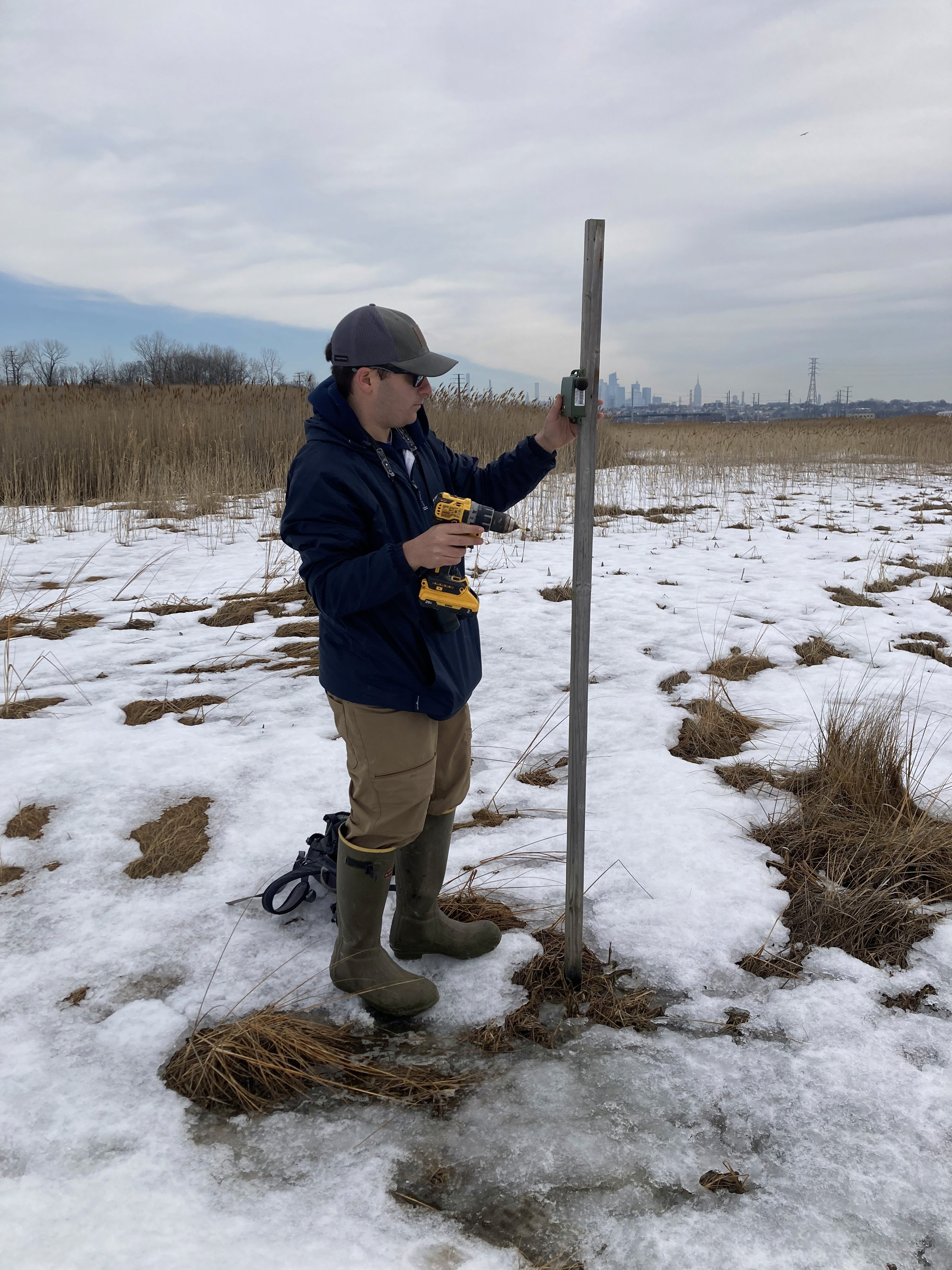
Above: Mike Turso from MRRI deploying
ARUs (Autonomous Recording Units)
in New Jersey
Behind the discovery
Michael Turso, a wildlife biologist at the Meadowlands Research and Restoration Institute (MRRI), stepped into that knowledge gap. The institute had spent years developing acoustic monitoring infrastructure for other purposes, including bat surveys, with some hardware supplied by the U.S. Fish and Wildlife Service. Turso saw a more focused use for it: to use that same infrastructure to listen for the leopard frog and determine whether the long-held but unconfirmed assumption was true.
The obstacle was noise. The Meadowlands are surrounded by a constant wall of human-made noise - traffic, industry and air traffic - so pervasive that researchers genuinely questioned whether acoustic recording units could detect a frog call through it. Turso's team deployed passive acoustic monitoring across a network of sites and relied on Arbimon's pattern-matching and random forest models to do what a human ear, worn down by hours of highway hiss, eventually cannot: distinguish the species' low, quacking call from everything else competing for the same frequency. The team also found that combining multiple acoustic indices, rather than relying on a single measure, produced a clearer signal. That proved especially valuable in a landscape where nearly every recording carries traces of the city pressing in on the wetland.

Above: Audio call of leopard frog chorus
The Reveal
The study, published in Urban Naturalist in 2024, found that the frog's general distribution across the Meadowlands had remained largely unchanged since the area was last systematically surveyed.
That stability is more significant than it first appears. It does not mean the species is thriving by any measure. Its range across the broader Mid-Atlantic is already fragmented, with isolated populations scattered from Connecticut through the New York metropolitan region and into the Carolinas, separated by highways the frogs rarely cross. Rather, it means that, despite a fairly bleak outlook, the Meadowlands population has not declined further. Given the alternative - discovering a population collapse a decade too late - unchanged is, in itself, good news, even if only cautiously so.
What happens with that evidence depends largely on the frog's value as an indicator species - an unusual reality for conservation science. MRRI has built its restoration strategy around two flagship species in the district, the leopard frog and the salt marsh sparrow, using their presence, absence and breeding success as practical indicators of whether restoration efforts have been successful over time. The frog is no longer just a subject of study; it has become an indicator of whether a wetland is truly healthy.

Habitat threats: Hurricane Katrina

Habitat threats: Industrialization

Habitat threats: Pollution
Opportunity
Much of MRRI's work is funded through annual government allocations and depends on the credibility the institute can demonstrate when future funding decisions are made. A flagship species with a decade of consistent monitoring data can make a stronger case for continued investment than technical discussions of monitoring methodology alone. In that sense, the frog's quack becomes more than a call—it serves as testimony to the value of protecting and restoring the Meadowlands.
The practical outcome is that the frog now serves as an early indicator of the Meadowlands' ecological health. Its presence at a site is used as a proxy for water quality and habitat function, while its absence may indicate declining habitat quality or environmental change. It also plays an important role in the local food web, moving nitrogen between water and land as it travels between breeding sites and foraging grounds, consuming mosquitoes and ticks, and providing food for herons, snakes and raccoons in turn. None of that required the frog's cooperation. It required someone to check.
There's a particular kind of irony in a species receiving renewed attention partly because almost nobody had heard of it. The Meadowlands aren't an exotic, faraway ecosystem; they're visible from the New Jersey Turnpike, sandwiched between a sports complex and a landfill, in one of the most densely surveyed regions of the country. And yet the frog went a decade after its discovery without a formal population assessment, simply because the calendar of "who looks for what, and when" hadn't caught up to the calendar of "what was just described as its own species." The Mid-Atlantic Coast Leopard Frog's story is, for now, a quiet one: a species rediscovered not through crisis but through someone finally asking a basic question and having the patience—and the right microphones—to sit through the static for an answer. That's a less dramatic narrative than a last-minute rescue, but possibly a more useful one. The frog isn't safe. Saltwater is still moving inland, the highways aren't going anywhere, and roughly nine-tenths of the habitat it depends on has already been developed. But for the first time in over a decade, someone is listening closely enough to notice if that changes.
References.
Meadowlands Environmental Research & Restoration Institute and New Jersey Sports and Exposition Authority (December 2024) https://njmc.s3.us-east-2.amazonaws.com/MRRI/pdfs/FinalReport_Dec2024.pdf
Michael J. Turso (2024) Using Passive Acoustic Monitoring to Assess the Distribution of a Rare Frog in the NJ Meadowlands Urban Naturalist, No. 73
Bloustein School of Planning & Public Policy (2023), Rising Tides, ArcGISStoryMaps
Arbimon (finish reference)
Stay in the loop.
Get more stories like this from the frontlines of conservation.
We respect your privacy. We also hate spam.
Listen to a live preview.
Download the app to access our free library of rainforest live streams and species calls.